Are Montreal commercial property owners paying more than their fair share in taxes? That’s the question many are asking as they get their bills for 2013.
“I have my tax bill for 2013 and it is $17,581.53 for the period from January 1 until December 31,” said Philippe Sarrasin, the co-owner of la Librairie de Verdun and president of SDC-Wellington. The bill covers only 2,700 square feet of space in a commercial condo at 4455 Wellington Street.
With 12 residential condos above his store, Sarrasin says that the new building on a former parking lot has created a mini-urban community of the sort that Montreal should be encouraging. Instead, his property taxes now are four times what they were when he rented the same amount of space in an older building at 4150 Wellington in 2010.
“It’s not like I moved across the country or even across the city,” he said. “I just moved two blocks down the street, yet my taxes quadrupled from the $4,000 I was paying to sixteen thousand dollars. I couldn’t believe it. It was like a ton of bricks on my head. Even my architect didn’t know it would go up this much. This is the exact opposite of what a city should be doing. Don’t they want to encourage renewal of the urban space? If had known that it would go up this much, I wouldn’t have moved. We’ve had to cut one full time job since that time.”
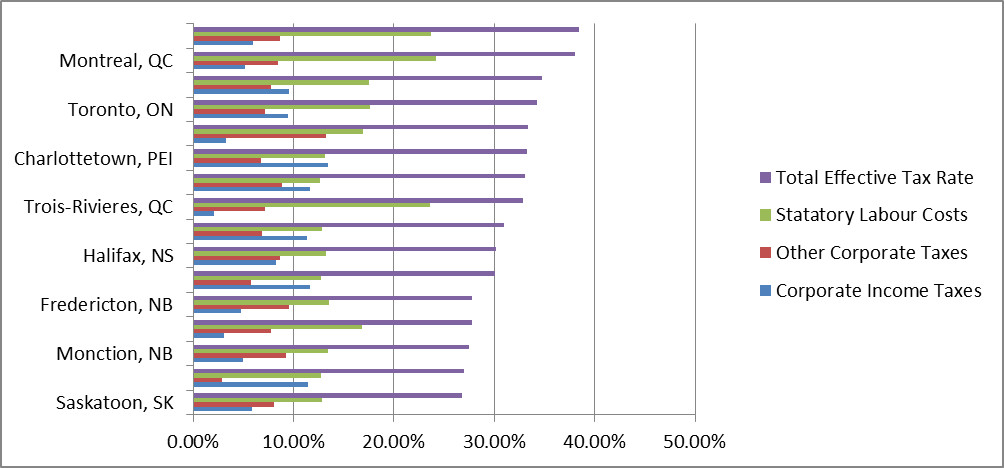
He’s not alone. According to a study sent to Montreal’s tax department in January, commercial tax rates in the city are higher than anywhere else in the country. They average out to $39.85 per $1000 worth of evaluation assessment, a rate that is significantly above the Canadian average of $27.30. The study was conducted by Altus Group for the Real Property Association of companies, trusts, pension funds, banks and others with investment real estate assets worth $100 million or more. The study, which compared property taxes in Calgary, Edmonton, Halifax, Ottawa, Montreal, Toronto, Winnipeg and Vancouver, was completed last September.
One chart indicates commercial property rates in Montreal increasing in two rapidly rising trends before and after 2009 from about double the residential rate in 2003 to the 2012 situation, in which commercial property owners paid more than four times what their residential neighbours paid.
The same chart shows the two most expensive cities in the country, Vancouver and Toronto, lowering rates for their commercial and industrial property owners.
“Montreal continues to trend upwards at an alarming rate that will likely vault them past Toronto by next year and will be rapidly approaching Vancouver should their ratio continue to increase,” says a January 4 letter to Montreal tax officials written by Real Property Association executives Michael Brookes, Chief Executive Officer and Government Relations & Policy Manager Ryan J. Eickmeier. “Montreal is quickly becoming an unfavourable place for businesses to locate as commercial rates rise steadily, causing them to look to other cities where the tax environment is more palatable. REALpac recommends that the City of Montreal work towards a reduction in their commercial property tax rate.”
———————-
Note: This article appeared in the Suburban on February 2 with two errors; the business size was too large and the address was incorrect. Those errors were mine and I regret them.
